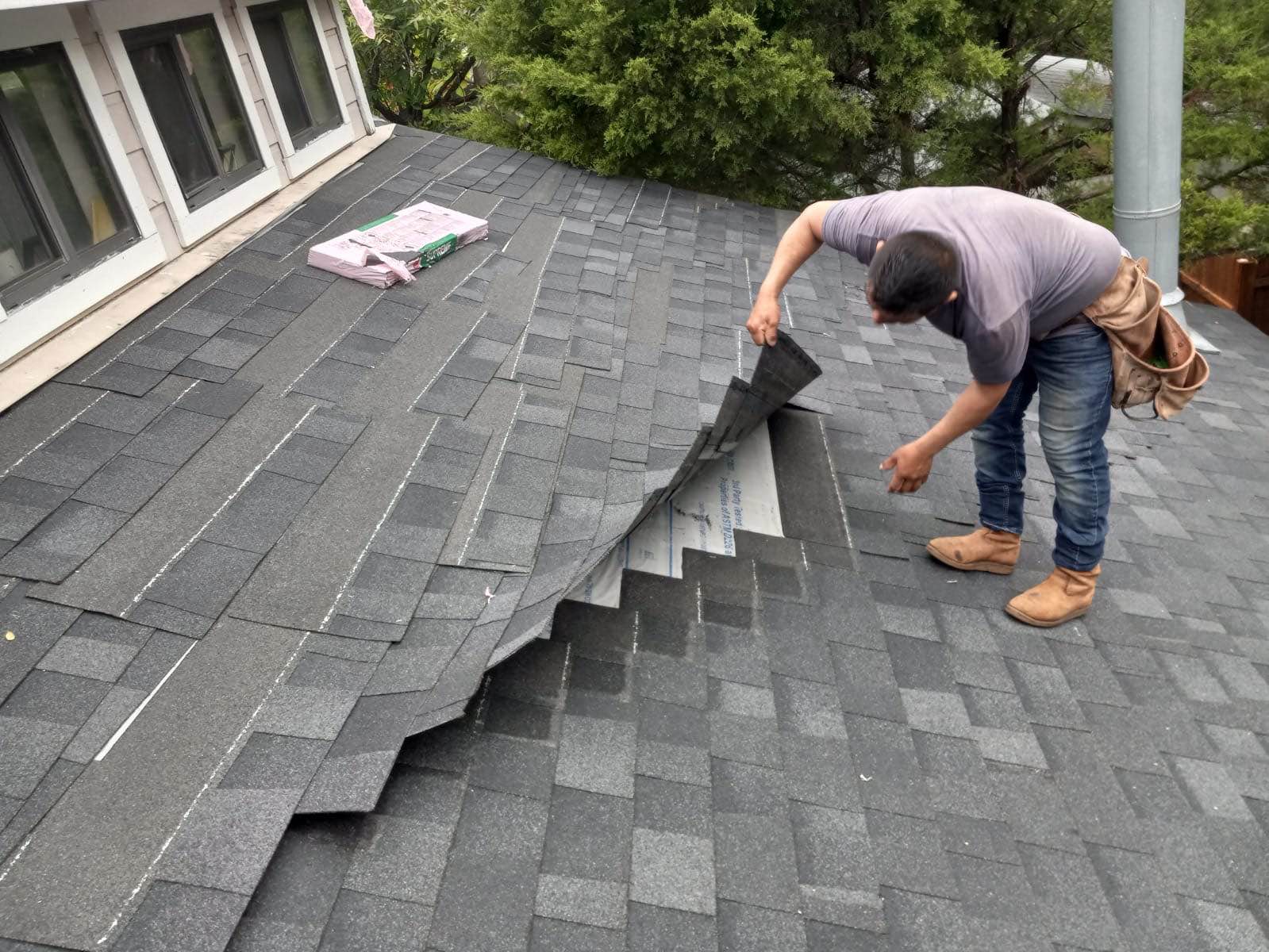
A wet patch on a bedroom ceiling almost never sits under the place the water got in. Water lands on the roof deck, runs down the sheathing or along a rafter, and drops through the first gap it finds — which can be several feet away and one room over. So the first job on any leak is not patching. It is tracing.
Here is how we work through it, and how you can tell whether you are looking at a repair or the end of a roof.
Start with the penetrations, not the field. On most roofs we look at, the shingles across the open field are in better shape than the homeowner expects. What has failed is something that goes through the roof: the rubber boot around a plumbing vent that has gone brittle and split, the step flashing where a wall meets the roof plane, the counter-flashing at a chimney, or a valley that was never lined properly. Those are all repairs, and they are usually a fraction of a re-roof.
Shore roofs age unevenly. Salt-laden air and constant wind accelerate everything on the exposed elevations, so it is completely normal for a south or east face to be visibly further gone than the sheltered side of the same roof. That matters for the decision: sometimes the honest answer is that one plane needs work now and the rest has years left.
The things that say repair. A single leak with an obvious source. Shingles that are still flexible and holding their granules. Flashing failures. Storm damage limited to one area. A roof under about fifteen years old with no widespread granule loss. In those cases a repair is genuine value, not a delaying tactic.
The things that say replacement. Granules filling the gutters, so the mat underneath is losing its UV protection. Shingles that are curling, cupping or cracking across the whole roof rather than in one spot. Multiple leaks in different areas at once. A deck that feels soft underfoot, which means water has been getting in long enough to rot the sheathing. And a second layer of shingles already on there, which limits what a repair can achieve and hides what is underneath.
Age alone is not the test. An architectural shingle roof that was properly ventilated can outlast a cheap three-tab roof by a decade. What matters far more than the date on the paperwork is what the attic looks like — because the underside tells you the truth. Daylight through the deck, rusted nail tips, damp insulation, dark staining on the rafters or a mildew smell all say that moisture has been getting in for a while, whatever the surface looks like from the street.
Ventilation is the quiet cause. A lot of roofs around here fail early not because of the shingles but because the attic could not breathe. Without balanced intake at the soffits and exhaust at the ridge, heat and moisture build up under the deck, cook the shingles from beneath in summer and condense on the sheathing in winter. If we are looking at a roof that has aged faster than it should have, the ventilation is the first thing we check — because replacing the roof without fixing it just restarts the same clock.
What we will not do is tell you a roof needs replacing when it needs a boot and a length of flashing. There is more money in the bigger job, which is exactly why you should get the reasoning in writing, with photographs of what is actually wrong, before you agree to anything. Ask for that from every contractor who looks at it.
One shore-specific note on timing. If a repair will hold the roof through the winter safely, it is often worth doing the repair now and planning the replacement for the spring, rather than starting a re-roof with a storm forecast. We will tell you when that is the sensible order.
Not sure which one you are looking at? Call Jersey Shore All Contractors Pro at (732) 921-6100 and we will trace the leak, photograph what we find, and give you a written price for the repair and an honest view on whether the roof is worth it. Licensed and insured, NJ HIC #13VH09847900. Seniors and larger jobs get 15% off.